

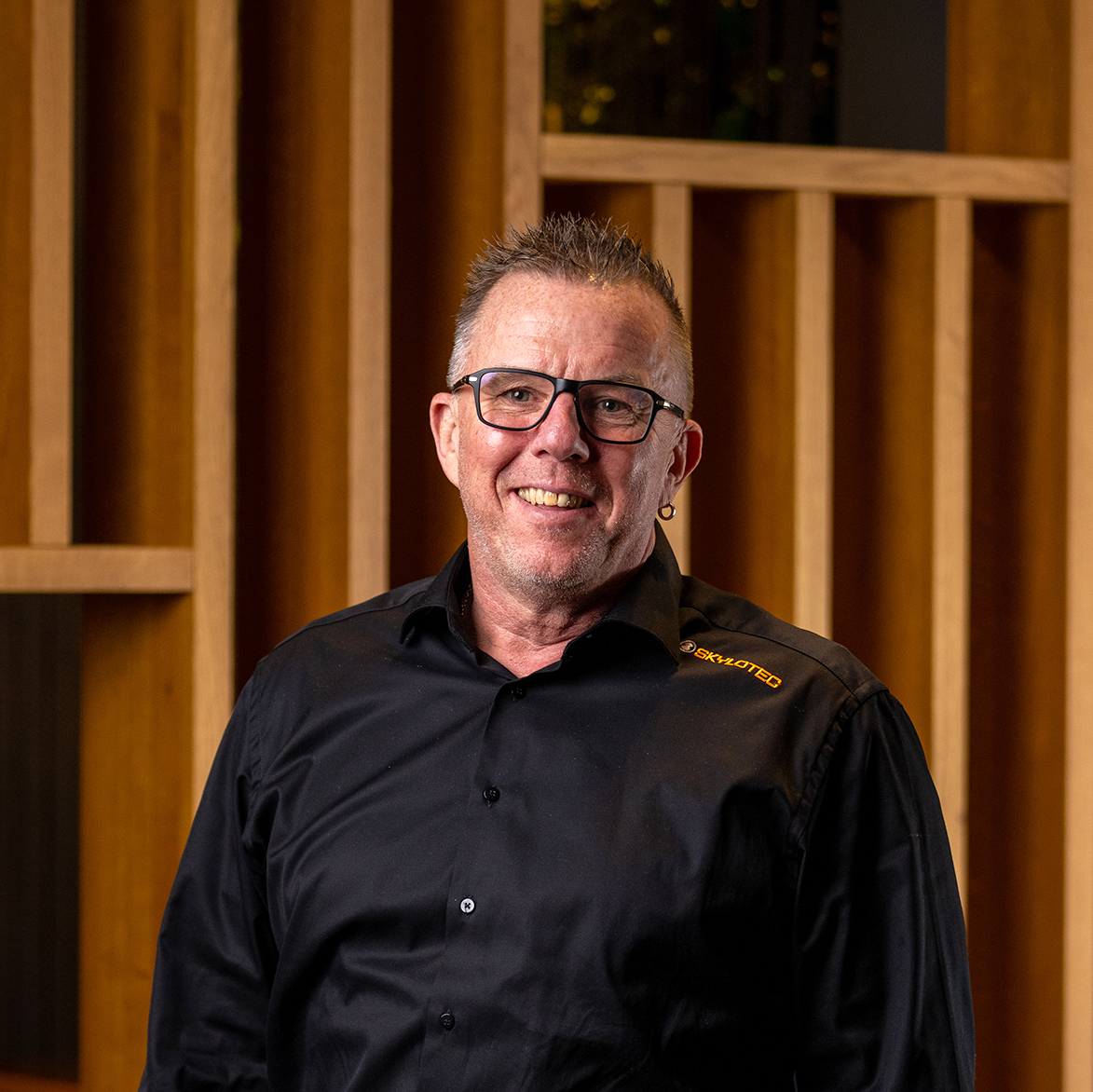
But which solutions actually make sense in practice? Frank Klinnert, Sales Manager for Fall Protection Systems, explains.
Who are you and what do you do at SKYLOTEC?
Frank: I’m Frank Klinnert from SKYLOTEC and Team Lead Sales DACH. In this context, DACH actually has a double meaning: on the one hand, I am responsible for our fall protection systems for roofs and façades; on the other hand, I look after the DACH region, meaning Germany (D), Austria (A) and Switzerland (CH).
SKYLOTEC is a family-owned company based in Neuwied and has been on the market for more than 75 years. We develop and manufacture fall protection systems and personal protective equipment against falls from height that make working at height safer and easier.
One important point: we manufacture exclusively in Europe. This makes us less dependent on customs issues, supply chain problems or global crises. In short, we help ensure that people working at height stay safe and return home healthy at the end of the day.
When people think of SKYLOTEC, many first think of harnesses, ropes and anchor points.
In reality, however, our offering is much broader. What exactly do you cover for roofers and skilled trade businesses?
Frank:
The easier question would almost be: what don’t we cover?
In the field of personal fall protection equipment, we offer a wide range of full body harnesses, anchor devices, fall arrest blocks and rescue devices. We are also Europe’s largest manufacturer of carabiners.
For roofers in particular, however, our safety systems for roofs and façades are especially relevant. These include rope and rail systems, collective protection measures such as our SECU RAIL 2.0 guardrail system, as well as single anchor points.
This is complemented by training, maintenance and installation services. We cover this through our 360° service cycle. It starts with a risk assessment together with the customer on site, continues with the evaluation of the current situation and the development of a suitable project solution, and extends through to installation and documentation.
For the customer, this means fewer interfaces, less coordination effort and significantly less stress.
One term comes up particularly often on roofs: SEKURANT. Many people use it almost as a generic term for anchor points. What is behind the original?
Frank: That’s right. SEKURANT is a registered trademark of SKYLOTEC and refers exclusively to one of our products. SEKURANT has been on the market for more than 55 years. I myself have been working with this product for more than 33 years across different companies. Its success is primarily based on continuous further development.
A good example is the new SEKURANT X20/X50 series. Here, we have developed a system that is strongly geared towards everyday work on roofs. The anchor points are easy to install and can be used on many different substrates.
For roofers, this means less installation effort, fewer potential sources of error and greater legal certainty, as the required approvals are in place.
There are situations where standard solutions are not enough. Scaffolding or mobile elevating work platforms are not always possible or economically viable. What role do rope access techniques and specialised solutions play in these cases?
Frank:
When scaffolding or mobile elevating work platforms cannot be used, rope access techniques become extremely important.
We fully equip rope access technicians, from specialised harnesses to motorised ascent devices such as ActSafe Power Ascenders. This is specialist equipment designed for the highest demands, while still being simple and intuitive to operate.
This also becomes interesting for roofers when it comes to material transport. If setting up a crane is not possible or not economically viable, these devices can be used to transport loads of up to 220 kilograms to height.
Rescue is a particularly important point. A fall into the rope is only the first part. After that, the person must be rescued safely. What do companies need to consider here?
Frank:
That is a key point. It is also referenced several times in the new DGUV Information 201-056.
When personal fall protection equipment is used, a rescue concept and a suitable rescue device must be available on the construction site. The best equipment is of little use if, in an emergency, nobody knows how the rescue procedure works.
For this purpose, we offer various rescue kits designed to be as simple as possible. One example is our ROOFWORXX KIT.
It can be used as a lanyard when working at the roof edge. In the event of a fall, a second person can lower the casualty in a controlled manner using the integrated SIRIUS device.
Another example is our MILAN POWER in the SEAL PAC. In this system, the rescue device, rope and accessories are stored in a sealed plastic bag. In an emergency, the casualty can be released from the lanyard and lowered safely.
The major advantage: the SEAL PAC remains sealed for 15 years. After that, it is inspected at the Service Center and, if the result is positive, can be sealed for another 15 years. This makes it a solution with a service life of up to 30 years.
However, one thing remains crucial: the rescue scenario must be trained in advance. Equipment alone is not enough if the team is not capable of taking action in an emergency.
This brings us directly to the topic of training. How do you support companies in properly training their employees?
We offer various training courses at our Vertical Rescue College. These include classic user training for personal fall protection equipment, training on the installation and maintenance of our systems, rescue from heights and confined spaces, as well as specialised training for rope access work.
Dates and course content can be found on skylotec.com. However, many training courses can also be delivered individually by our trainers directly at the customer’s site.
After successful participation, participants receive a corresponding certificate. For companies, this is important because it not only helps them qualify their employees, but also makes it easier to meet their documentation obligations.
Finally, let’s take a look at DGUV Information 201-056. The requirements for protective measures against falls from roofs have been described in much greater detail. What do roofers now need to pay particular attention to?
DGUV Information 201-056 has been extensively revised. Its scope has grown significantly: from 24 pages with 4 chapters to 96 pages with 9 chapters and additional annexes. Its purpose has also changed. It is no longer just a planning basis for anchor devices, but a planning basis for selecting fall protection systems. The hierarchy of protective measures is particularly important. Collective protection takes priority over personal protective equipment. That is not new, but it is now emphasised much more clearly. One crucial point for roofers is this: if personal fall protection equipment is used, a rescue concept must be in place. In addition, a suitable rescue device must be available on the construction site. This point is addressed several times.
The documentation of installation, the required competence and expertise, and responsibilities are also described more clearly. We support this with our rescue devices, rescue concepts, training courses at the Vertical Rescue College and digital documentation solutions.
The goal is to enable our customers to meet the requirements safely, without unnecessary effort and without losing time.
This fits perfectly with our brand promise: We get you there.

You wish contact by telephone?
We are happy to help you by phone.